
致命魔术
C919 completes first scheduled international commercial service_我的网站

一 | 4月19日,广西桂林,网友看外面电闪雷鸣,跑到高层楼的安全位置拍下了闪电频发的一慕:“如同科幻大片,见到频率如此之高,感觉非常震撼。
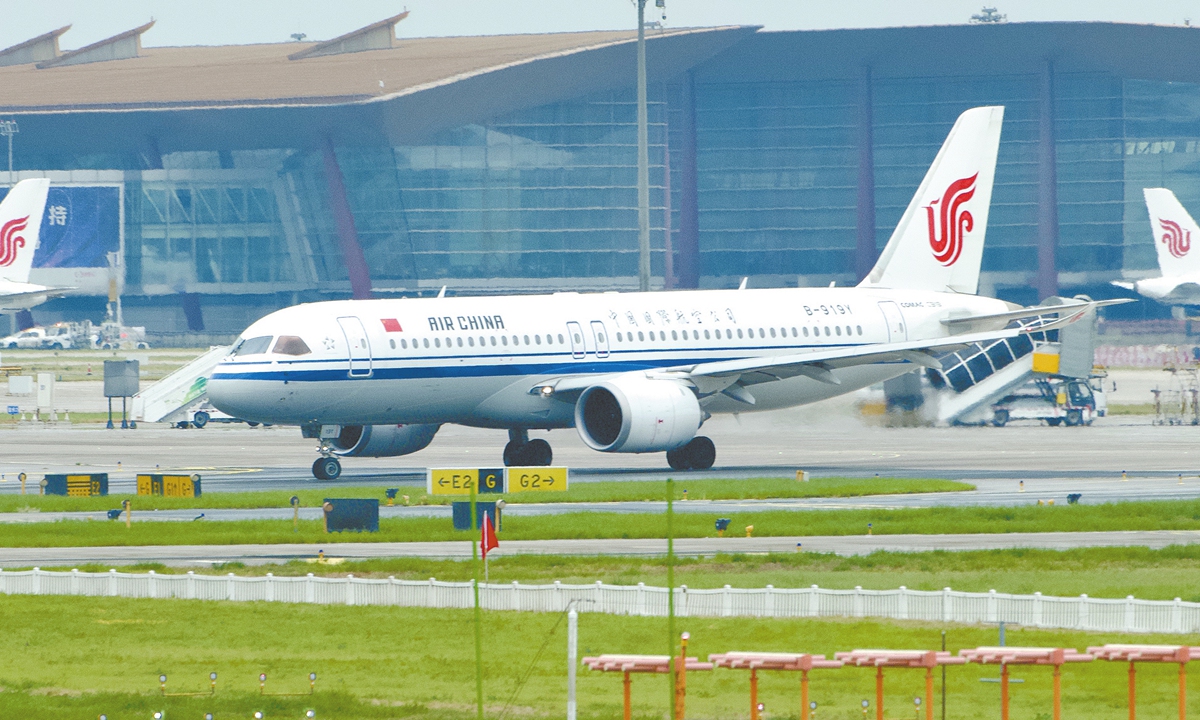
As the C919 climbs higher and flies farther beyond China's borders, the runway behind it gradually disappears. What comes into focus instead is a much broader journey - one in which China's advanced engineering capabilities are reaching new markets, new partners and new possibilities around the world.
Historic moment
Hours before takeoff, a passenger surnamed Zhang, who was completing check-in procedures at Beijing Capital International Airport, said with a smile that he had stumbled into a "historic moment" by chance.
"I didn't pay much attention when I booked the ticket. I had heard that our homegrown C919 would soon begin international service, but I never expected it would be this very flight," Zhang told the Global Times on Wednesday. "I feel incredibly proud and excited."
From its maiden flight in Shanghai in 2017, when its first takeoff had many watching with bated breath, to its first scheduled international commercial service today, the C919's journey reflects China's sustained push to build up its capabilities in advanced aviation manufacturing.
In recent years, China's top-level policies have strongly supported the development of high-end manufacturing. As the nation enters the opening year of the 15th Five-Year Plan period (2026-30), Chinese high-end manufacturing is increasingly translating technological breakthroughs into globally competitive products and solutions to contribute more broadly to industrial development and connectivity worldwide, Chinese experts noted.
And the C919 program is one of China's most ambitious endeavors to push the frontiers of high-end manufacturing.
The C919 is China's first self-developed trunk jetliner in accordance with international airworthiness standards and registered with independent intellectual property rights, according to the Xinhua News Agency on Wednesday.
Industry experts said the C919's progress reflects the rapid advance of China's broader manufacturing capabilities. Only a handful of countries are capable of developing single-aisle mainline passenger jets, and even fewer can bring a certified aircraft into commercial service.
The C919 aircraft's biggest achievement is that China has built the capability to take a large passenger jet from the drawing board all the way to a certified commercial product, covering overall design, airframe manufacturing, system integration and airworthiness approval, Wang Ya'nan, editor-in-chief of Beijing-based Aerospace Knowledge magazine, told the Global Times on Wednesday.
Much of the aircraft's design, major structural manufacturing and key systems are completed in China. He said this marks a significant step forward in China's civil aviation manufacturing capability, placing the country among the few able to develop a modern trunk-line jet and bring it into commercial service. Its expanding operations now represent the next stage of that progress, he added.
As of Monday, the C919 aircraft had served 57 routes linking 25 cities and handled more than 7.5 million passenger trips, said the Commercial Aircraft Corporation of China (Comac), the jet developer, according to Xinhua.
However, the C919 still faces intense competition in a global market dominated by established players. Experts said, however, that its competitiveness could continue to strengthen as operational experience grows and China accelerates indigenous development of key components and systems.
The UK-based aviation industry publication Airline Economics noted on July 13 that Malaysia Airlines continues to consider Comac's C919 as a future fleet option, but Western regulatory certification remains a key requirement before the carrier would consider operating the Chinese narrowbody.
This has also brought into sharper focus the dual considerations of certification and market demand among potential international customers for the C919, as Wang said this is precisely why the C919's continued expansion into new routes and markets matters.
As cross-border services expand, the C919 will also need to move closer to international operating standards by building a support network that goes beyond its domestic maintenance system to cover the full cycle of international operations, including regulatory coordination, overseas maintenance facilities and spare-parts logistics, Han Tao, an expert with China's civil aviation think tank, told the Global Times on Wednesday.
Strengthening these capabilities will be crucial to supporting more international routes and meeting the standards and operational needs of potential overseas customers, Han said.
Meanwhile, industry observers noted that China is also stepping up efforts to advance key components and systems for large commercial aircraft, an area that remains a major challenge for most countries' aviation industries, with mature capabilities still largely concentrated in the US, the UK and France.
Pushing boundaries, sharing opportunities
As the C919 flies farther, it is carrying with it not only China's advances in high-end manufacturing, but a broader story of how Chinese innovation is moving from breakthroughs at home to new possibilities shared with the world.
Underpinning that shift is China's expanding advanced manufacturing capacity and increasingly complete industrial ecosystem, which are helping turn technological breakthroughs into scalable products, a Chinese expert said.
China is upgrading its traditional industrial base while cultivating new sectors that could shape future competitiveness, seeking to move beyond scale and cost advantages toward a more innovation-driven industrial model, injecting new impetus into the country's high-quality development, according to Xinhua's another report on July 21.
The nation's 15th Five-Year Plan underscores the development of a modernized industrial system with advanced manufacturing as its backbone, the report said.
China's vast and diverse market provides advanced manufacturing with something equally important as technological capability: abundant real-world scenarios for testing, refinement and commercialization, Bian Yongzu, executive deputy editor-in-chief of Modernization of Management magazine.
This helps turn breakthroughs into mature, scalable products more quickly. Over the longer term, he said, advanced manufacturing will strengthen China's competitiveness by combining stronger industrial capabilities with complete supply chains and global cooperation, allowing more Chinese technologies, products and solutions to reach international markets, Bian said.
Aviation manufacturing, as a key pillar of high-end manufacturing, is benefiting from this broader push toward industrial upgrading and technological innovation.
At the fourth China International Supply Chain Expo held in Beijing in June, a complete aviation industry innovation chain stands out, spanning aviation materials, core forgings and low-altitude economy applications, drawing widespread attention to the participating companies, Xinhua reported.
Bian said that a complex project such as the C919 can drive coordinated upgrades across advanced materials, precision equipment, core components, system integration, logistics and skilled talent. In this sense, building a large commercial aircraft is a comprehensive test of a country's industrial depth, supply-chain coordination, and ability to turn sophisticated technologies into reliable commercial products.
。 广西多地强降雨持续!这种天气何时消停? 21日9时至10时的1个小时内,广西防城港市防城区降雨量达到80.6毫米!相当于1平方米面积内1小时倒下160瓶矿泉水,足见雨势之猛烈。 20日至21日,广西的北部和中部出现持续暴雨天气过程,并伴有大范围的强对流天气。其中,20日上午8时至9时,一个弓形回波在东移的过程当中还出现了龙卷,在梧州藤县陶瓷园触地约3公里范围。 据统计,4月20日08时至21日08时,9个市的28个县(市、区)的92个乡镇有大暴雨,12个市的73个县(市、区)的353个乡镇有暴雨,最大为梧州藤县埌南镇232.7毫米。12个市的50个县(市、区)的126个乡镇有17.2米/秒(8级)以上大风,最大为北海市海城区涠洲镇35.7米/秒(12级)。百色、河池、来宾、南宁、钦州、桂林等6市19个县(区)局地出现冰雹。 过程以来桂东累计雨量大。据统计,4月19日20时至21日08时,桂林市阳朔县阳朔镇降雨量259.9毫米,100~250毫米有10个市的52个县(市、区)的268个乡镇,50~100毫米有13个市的88个县(市、区)的527个乡镇。

二 | 这样的天气何时才能消停? 广西气象台首席预报员农孟松表示,从20日开始,广西正式进入前汛期。

三 | 21日白天,广西的强降水和强对流转移到桂南,主要出现在南宁、贵港、梧州以及沿海三市。

四 | 22日开始,强降水将趋于减弱,但是沿海三市仍然还有较强降水和强对流天气,需要做好防范。 广西气象台预计,22日,降雨明显减弱,桂南、桂西有小到中雨、局地大雨到暴雨并伴有短时雷暴大风等强对流天气,桂北阴到多云有阵雨或雷雨、局地大雨;23日,桂南阴到多云有阵雨或雷雨,其中桂东南有中雨、局地大雨,桂北多云。 南宁市气象台预计,22日白天全市有小到中雨、局部大雨并伴有短时雷暴大风等强对流天气,气温 21至26℃;22日晚全市阴天、局部有阵雨,气温21至23℃;23日白天全市阴转多云,气温20至29℃。 (图源网络 中国小康网综合无棣县融媒体中心、南宁晚报)。
Current article:http://muq5o.tandianxiuzhutiaoshoudiamei.pics/list_desuw/pxc.html
Published on:02:43:31
栏目相关
- Makers of Dhurandhar drop Ishq Jalakar – Karvaan ahead of schedule on fan demand
- 台女星穿黑色透视装用"美人计" 男演员直言本色出演
- 王毅访问新西兰,与总理和外长会面:都谈了啥?
- Samples from Asteroid May Provide Clues to Life on Earth
- 《Intergalactic: The Heretic Prophet》卡司阵容扩充,迎来《UNCHARTED™: 盗贼传奇合辑》与《最后生还者:第一部》资深成员加盟
- 国庆假期酒店预订率辽宁领跑全国
- 世界上第一部5G手机Moto Z3于2019年在CES推出:比当前网络速度快10倍
- 戦争疲れに神経とがらせるプーチン政権、「痛み」隠すイルミネーション…独ソ戦超えで高まる平和求める声
- 무안공항 참사 원인 ‘조직적 은폐’ 혐의 국토부 직원 7명 송치
- 第五人格IVL:FPX.ZQ_DongX顶住压力稳定追击,三抓终结比赛!
- 大ブレイクから18年 鼠先輩が現在の収入を赤裸々告白 都内に8000万円相当の一軒家を所有
- OpenAI和Anthropic冲刺IPO 行业融资缺口恐达8000亿美元
热门排行
- 冲刺四季度|望花区:切实把政策红利转化为发展动力
- 拜登签署新行政命令“扩大美国生物制造”再引国内CXO板块跳水 反复风险“预演”或倒逼产业发展_企业_拜登
- China central bank reform plan targets high-level financial opening-up
- Rashmika Mandanna Soaks in The Christmas Spirit
- Putin denounces Crimean Bridge explosion as terrorist act
- 小拉出行驶单乘客未付运费诉求平台协助追回
- 第一批AI受害者,是中小学语文老师
- Beijing launches flood response as heavy rain looms
- 便宜不少!曝华为新款P50 Pocket new折叠屏搭载骁龙778G,还有XMAGE影像和120Hz OLED屏幕_手机_微信
- 您好,顺风1月下旬开始试运行:上海、杭州、广州、成都等6个城市。
- Chinese ex-leader Hu Jintao left out of Congress ceremony
- 运动后想喝啤酒又怕白练?青岛轻干让运动后的快乐,不必纠结